We have various images about How to find increasing and decreasing intervals on a graph calculus in this post. You can find and download any images about How to find increasing and decreasing intervals on a graph calculus here. We hope you enjoy explore our website.
Currently you are searching a post about how to find increasing and decreasing intervals on a graph calculus images. We give some images and information related to how to find increasing and decreasing intervals on a graph calculus. We always try our best to publish a post with quality images and informative articles. If you cannot find any ideas or images you are looking for, you can use our search feature to browse our other post.
How To Find Increasing And Decreasing Intervals On A Graph Calculus. The first step is to take the derivative of the function. And the function is decreasing on any interval in which the derivative is negative. So let�s start with a so we know that a function is increasing when the graph goes up from left to right. Finding decreasing interval given the function.
 Google Drive BUNDLE POLYNOMIAL FUNCTIONS Distance From pinterest.com
A function is considered increasing on an interval whenever the derivative is positive over that interval. F0(x) > 0(f0(x) < 0) ⇒ is increasing (decreasing) example 3. If the value is negative, then thatinterval is decreasing. Now, let us take a point from the interval. The graph is increasing until x=1.5, then decreases. So this problem, we�re given the graph of f of x.
{eq}\displaystyle y = \dfrac {x.
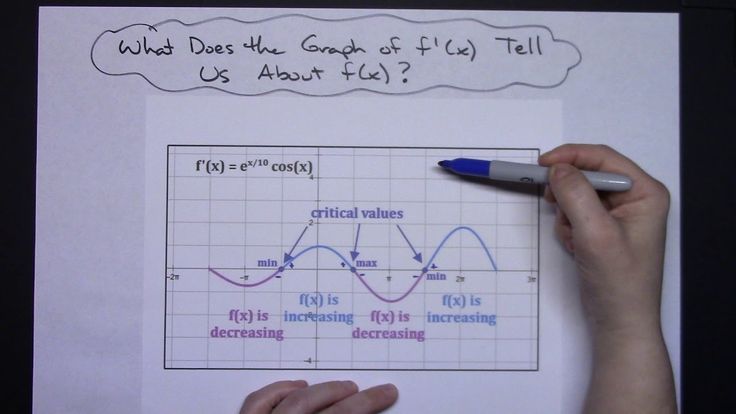
The average rate of change of an increasing function is positive, and the average rate of change of a decreasing function is negative. Because the derivative is zero or does not exist only at critical points of the function, it must be. A function is considered increasing on an interval whenever the derivative is positive over that interval. Then solve for any points where the derivative equals 0. To find intervals on which (f) is increasing and decreasing: Choose random value from the interval and check them in the first derivative.
 Source: pinterest.com
Then set f� (x) = 0. Procedure to find where the function is increasing or decreasing : Find the critical values of (f). Choose random value from the interval and check them in the first derivative. Then set f� (x) = 0.
 Source: pinterest.com
And the function is decreasing on any interval in which the derivative is negative. Find intervals of increasing, decreasing, and intervals of concavity up, down and point of inflection (s), use calculus to find these values exactly (if possible): Procedure to find where the function is increasing or decreasing : We can say this because its only a parabola. If f′(x) > 0 at each point in an interval i, then the function is said to be increasing on i.
 Source: pinterest.com
Because the derivative is zero or does not exist only at critical points of the function, it must be. So we�re looking for a cz. Attach is an image that may help you: Choose random value from the interval and check them in the first derivative. So to find intervals of a function that are either decreasing or increasing, take the derivative and plug in a few values.
 Source: pinterest.com
Since f � (x) < 0, hence the function is decreasing at this interval. As someone mentioned in the comments, the standard way to do this is the trick of completing the square (also often used to derive the quadratic formula). F0(x) > 0(f0(x) < 0) ⇒ is increasing (decreasing) example 3. If f′(x) > 0 at each point in an interval i, then the function is said to be increasing on i. Find the critical values of (f).
 Source: pinterest.com
Let�s try a few of these: As someone mentioned in the comments, the standard way to do this is the trick of completing the square (also often used to derive the quadratic formula). If the value is negative, then thatinterval is decreasing. Put solutions on the number line. Finding increasing interval given the derivative.
 Source: pinterest.com
We can say this because its only a parabola. So here in blues are function f of x and we are to find an open interval where f of x is for part a increasing and for part b decrease just by looking at the graph. So once you find out the function is increasing in the open interval ( a, b) by using differentiation criteria, then you can manually check that the conditions apply to the endpoints by showing that. Find the critical values (solve for f � (x) = 0) thesegive us our intervals. We can say this because its only a parabola.
 Source: pinterest.com
So once you find out the function is increasing in the open interval ( a, b) by using differentiation criteria, then you can manually check that the conditions apply to the endpoints by showing that. If the value is negative, then thatinterval is decreasing. We can say this because its only a parabola. So to find intervals of a function that are either decreasing or increasing, take the derivative and plug in a few values. So here in blues are function f of x and we are to find an open interval where f of x is for part a increasing and for part b decrease just by looking at the graph.
 Source: pinterest.com
F′(x) < 0 at each point in an interval i, then the function is said to be decreasing on i. If the value is positive,then that interval is increasing. That is, find all (c) in (i) where (f�(c) = 0) or (f�) is not defined. If f′(x) > 0 at each point in an interval i, then the function is said to be increasing on i. Next, we can find and and see if they are positive or negative.
 Source: pinterest.com
Now, choose a value that lies in each of theseintervals, and plug them into the derivative. Finding increasing interval given the derivative. The average rate of change of an increasing function is positive, and the average rate of change of a decreasing function is negative. Finding decreasing interval given the function. To see this formula is true, just multiply out.
 Source: pinterest.com
Since f � (x) > 0, therefore the function is increasing at this interval. So to find intervals of a function that are either decreasing or increasing, take the derivative and plug in a few values. The average rate of change of an increasing function is positive, and the average rate of change of a decreasing function is negative. Giving you the instantaneous rate of change at any given point. As someone mentioned in the comments, the standard way to do this is the trick of completing the square (also often used to derive the quadratic formula).
 Source: pinterest.com
So to find intervals of a function that are either decreasing or increasing, take the derivative and plug in a few values. Next, we can find and and see if they are positive or negative. To find increasing and decreasing intervals, we need to find where our first derivative is greater than or less than zero. So we�re looking for a cz. Fun‑4 (eu), fun‑4.a (lo), fun‑4.a.1 (ek) google classroom facebook twitter.
 Source: pinterest.com
If f (x) > 0, then the function is increasing in that particular interval. Giving you the instantaneous rate of change at any given point. Consider f0(x) = 2x−5 f0(x) > 0 if x > 5/2, f0(x) < 0 if x < 5/2. If our first derivative is positive, our original function is increasing and if g�(x) is negative, g(x) is decreasing. F0(x) > 0(f0(x) < 0) ⇒ is increasing (decreasing) example 3.
 Source: pinterest.com
Finding increasing interval given the derivative. Because the derivative is zero or does not exist only at critical points of the function, it must be. Find the critical values of (f). We can say this because its only a parabola. Since f � (x) > 0, therefore the function is increasing at this interval.
 Source: pinterest.com
So this problem, we�re given the graph of f of x. For this particular function, use the power rule: And the function is decreasing on any interval in which the derivative is negative. Choose random value from the interval and check them in the first derivative. How do we determine the intervals?
 Source: pinterest.com
As someone mentioned in the comments, the standard way to do this is the trick of completing the square (also often used to derive the quadratic formula). The derivative of a function may be used to determine whether the function is increasing or decreasing on any intervals in its domain. The graph will help you visualize it better. To find increasing and decreasing intervals, we need to find where our first derivative is greater than or less than zero. So, find by decreasing each exponent by one and multiplying by the original number.
 Source: pinterest.com
Determining intervals on which a function is increasing or decreasing. We can say this because its only a parabola. So let�s start with a so we know that a function is increasing when the graph goes up from left to right. F0(x) > 0(f0(x) < 0) ⇒ is increasing (decreasing) example 3. Attach is an image that may help you:
 Source: pinterest.com
Fun‑4 (eu), fun‑4.a (lo), fun‑4.a.1 (ek) google classroom facebook twitter. Choose random value from the interval and check them in the first derivative. Find intervals of increasing, decreasing, and intervals of concavity up, down and point of inflection (s), use calculus to find these values exactly (if possible): A x 2 + b x + c = a ( x + b 2 a) 2 + c − b 2 4 a. Now, let us take a point from the interval.
 Source: pinterest.com
Finding intervals of increase and decrease of a function can be done using either a graph of the function or its derivative.these intervals of increase and decrease are important in finding critical points, and are also a key part of defining relative maxima and minima and inflection points. Find where f(x) = x2 − 5x + 1 is increasing and where it is decreasing. To find intervals on which (f) is increasing and decreasing: F ( x) = x 3 − 1 2 x. Put solutions on the number line.
Any registered user can upload their favorite photos found from the internet to our website. All materials used in our website are for personal use only, please do not use them for commercial purposes. If you are the owner of posted image above, and you do not want them to be here, please give a report to us.
Please support us by sharing this post about how to find increasing and decreasing intervals on a graph calculus to your social media like Facebook, Instagram, etc. Thank you.


